
 EN
EN  English
 Português




A diaphragm brake chamber is a pneumatic actuator that converts compressed air pressure into mechanical force at the brake assembly of a commercial vehicle -- when air enters the chamber, it pushes against a flexible rubber diaphragm, which moves a pushrod outward to actuate the slack adjuster and apply the brakes, generating output forces of 1,500 to 4,000 lbs from air pressures of 80 to 120 psi depending on chamber size. Every air-braked truck, bus, trailer, and semi-trailer in service relies on one or more diaphragm brake chambers per wheel position to translate the driver's brake pedal input into stopping force at each axle.
This guide explains in detail how diaphragm brake chambers work, the different types and sizes in use, how they compare to piston-type actuators, how to identify failure, and what maintenance and replacement practices keep commercial vehicles in safe, compliant operating condition.
Content
- How Does a Diaphragm Brake Chamber Work?
- What Are the Different Types of Diaphragm Brake Chambers?
- Diaphragm Brake Chamber Size Chart and Output Force Data
- How Does a Diaphragm Brake Chamber Compare to a Piston-Type Actuator?
- What Are the Key Components Inside a Diaphragm Brake Chamber?
- Why Do Diaphragm Brake Chambers Fail and How Do You Identify Failure?
- How to Inspect, Maintain, and Replace a Diaphragm Brake Chamber
- FAQ: Diaphragm Brake Chambers
- Conclusion: The Diaphragm Brake Chamber as a Safety Foundation
How Does a Diaphragm Brake Chamber Work?
A diaphragm brake chamber works by using compressed air to deflect a rubber diaphragm across a sealed chamber, converting air pressure acting over the diaphragm's effective area into a linear pushrod force that actuates the brake foundation assembly at each wheel end.
The core operating principle is straightforward pneumatic force conversion. The chamber consists of two pressed-steel housing halves clamped together at a center flange. A molded rubber diaphragm -- typically neoprene or EPDM reinforced with fabric plies -- is clamped between the two halves, dividing the chamber into a pressure side and an atmosphere side.
The complete operating cycle of a diaphragm brake chamber follows this sequence:
- Brake application: the driver presses the brake pedal, signaling the brake valve to deliver compressed air (typically 80 to 120 psi from the vehicle's air reservoirs) through the supply port into the pressure side of the chamber
- Diaphragm deflection: the incoming air pressure acts across the entire effective area of the diaphragm -- typically 12 to 36 square inches depending on chamber size -- pushing the diaphragm and its attached pressure plate toward the non-pressure side of the housing
- Pushrod stroke: the pressure plate pushes a hardened steel pushrod outward through a sealed port in the non-pressure housing half, typically through a stroke of 0.5 to 3 inches during normal service
- Brake actuation: the pushrod connects to the slack adjuster arm, which rotates the S-cam or activates the wedge mechanism of the brake foundation assembly, spreading the brake shoes against the drum or clamping the disc rotor
- Brake release: when the driver releases the pedal, the brake valve exhausts the air from the chamber pressure side; a return spring inside the chamber pushes the diaphragm and pushrod back to the retracted position, releasing the brake
The output force of a diaphragm brake chamber is determined by the simple relationship: Force = Air Pressure multiplied by Effective Diaphragm Area. A Type 30 chamber with an effective area of approximately 30 square inches at 100 psi supply pressure produces approximately 3,000 lbs of pushrod force -- sufficient to generate the brake torque needed to stop a fully laden Class 8 truck axle from highway speeds.
What Are the Different Types of Diaphragm Brake Chambers?
Diaphragm brake chambers are produced in two fundamental configurations -- service chambers (which actuate brakes during normal driving) and spring brake chambers (which add a mechanical spring-loaded parking and emergency brake function) -- with service-only chambers used primarily on trailer axles and spring brake chambers used on truck drive axles and steering axles where parking brake capability is required by law.
Service Diaphragm Brake Chamber (Type 6 to Type 36)
The service-only diaphragm brake chamber is a single-chamber device that applies the service brake when air pressure is supplied and releases when air pressure is removed. It provides no parking or emergency brake function -- if air pressure is lost, the brake releases rather than applies. Service chambers are classified by their effective diaphragm area in square inches, with the most common sizes being Type 12, Type 16, Type 20, Type 24, Type 30, and Type 36. The type number corresponds approximately (but not exactly) to the effective area in square inches.
Service chambers are the most compact and lightest diaphragm brake chamber option. They are used on steering axles of trucks (where parking brakes are provided by the drive axle chambers) and on trailer axles where the vehicle's air system provides parking hold through a separate mechanism or the trailer is left coupled to a tractor with a full air system.
Spring Brake Diaphragm Chamber (Piggyback / Combination Chamber)
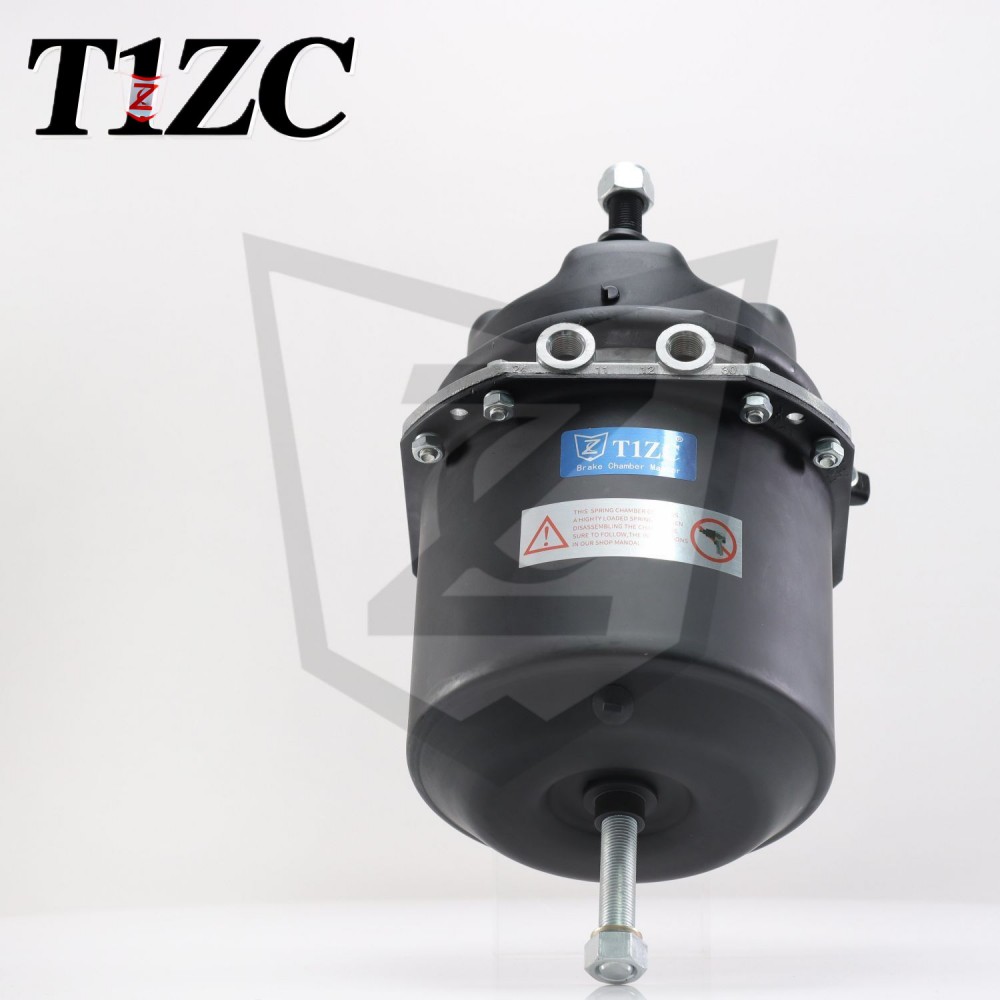
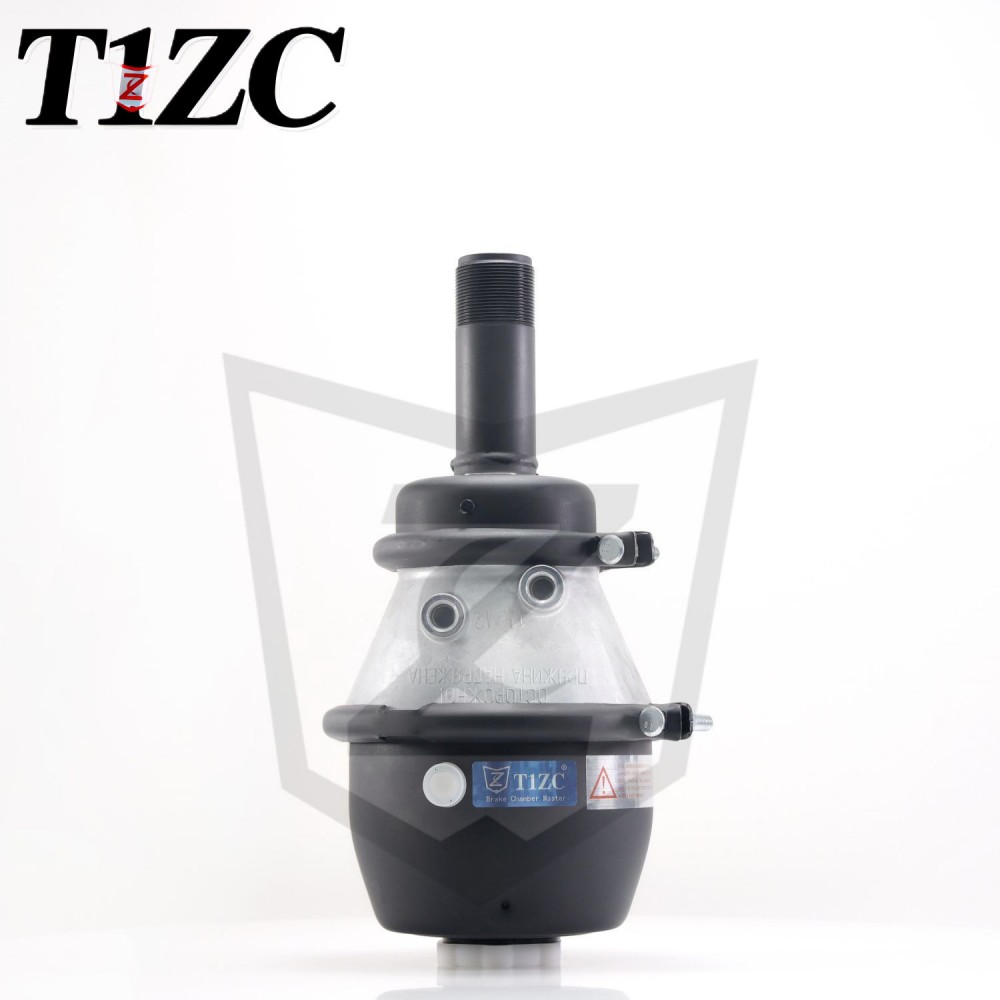
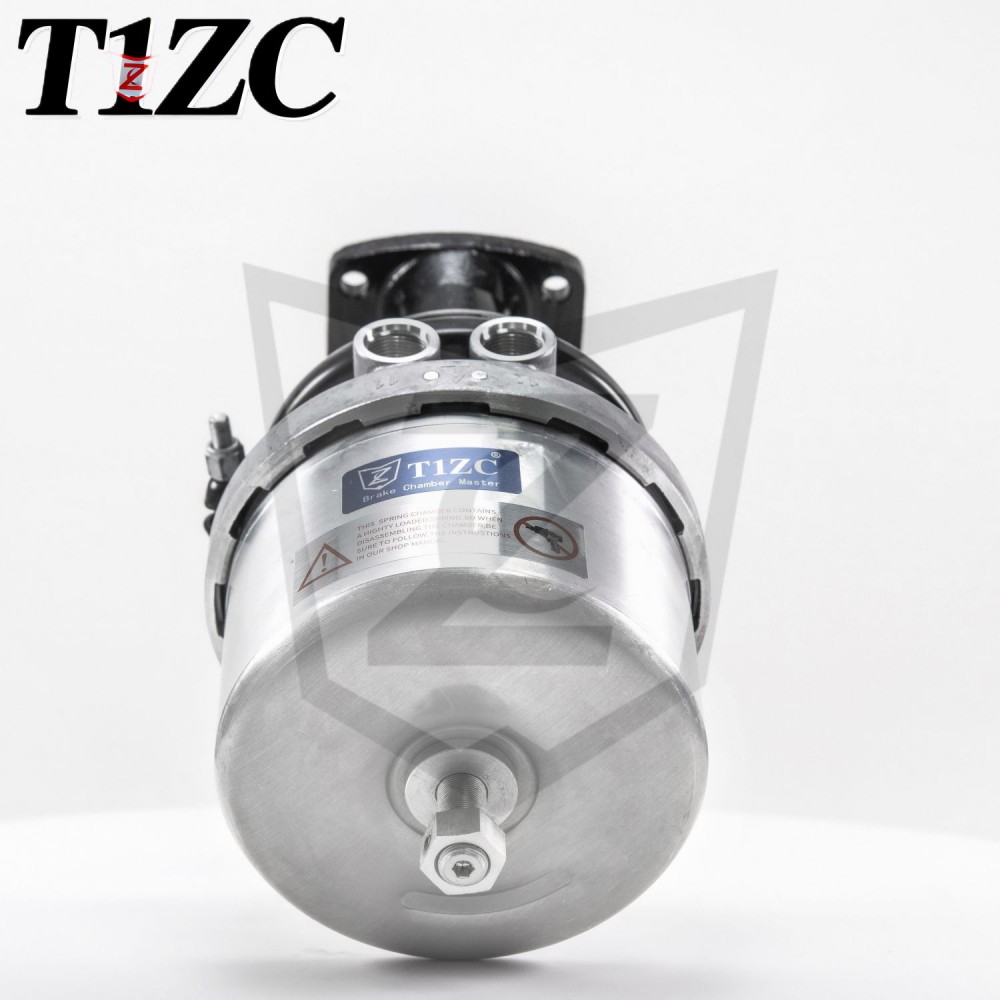
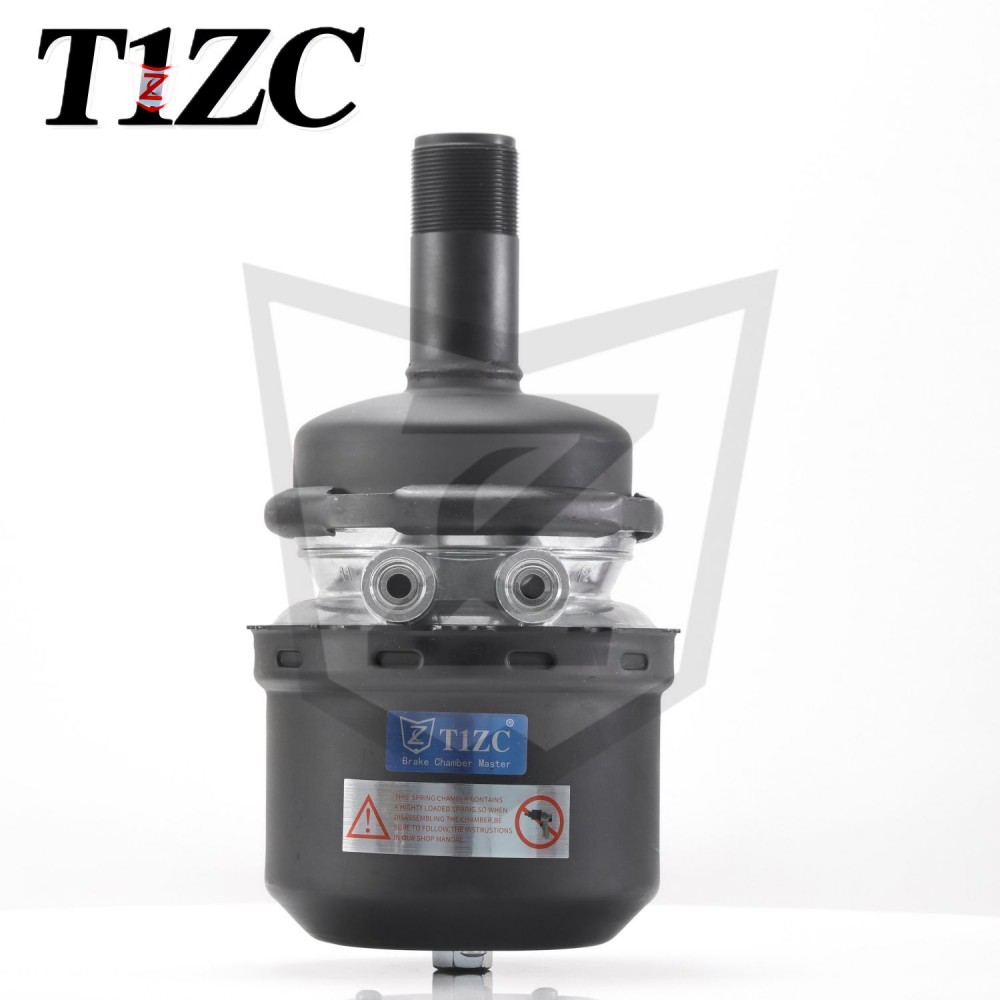
The spring brake chamber -- universally called a "piggyback" chamber in the trucking industry -- combines a service diaphragm brake chamber at the front with a spring brake actuator at the rear. The spring brake section contains a powerful coil spring (typically rated at 2,250 to 2,700 lbs of force at full compression) held in the compressed (released) position by air pressure during normal vehicle operation.
When air pressure in the spring brake section is reduced or lost (either by the driver engaging the parking brake control, or by an emergency air loss event), the powerful spring extends and drives a second pushrod -- called the power screw or emergency pushrod -- forward through the dividing wall into the service chamber section, pushing the service diaphragm and main pushrod outward to apply the brakes mechanically without any air pressure.
This design means that a vehicle with spring brake chambers will automatically apply its brakes if the air system loses pressure below approximately 20 to 45 psi -- a critical safety feature required by Federal Motor Carrier Safety Administration (FMCSA) regulations in the United States and equivalent regulations in other jurisdictions. The spring brake section uses a second separate diaphragm (the service section uses one diaphragm, the spring section uses another) making the spring brake chamber a true dual-diaphragm device in the most common configuration.
Common Spring Brake Chamber Size Designations
Spring brake chambers are designated by a two-number code indicating the service chamber size and the spring brake section size. For example:
- 30/30 chamber -- Type 30 service section combined with a Type 30 spring brake section; the most common size for Class 8 truck drive axles
- 24/24 chamber -- used on lighter truck drive axles and some bus applications
- 20/24 chamber -- asymmetric combination used where package space requires a smaller service section than spring brake section
- 16/16 chamber -- used on medium-duty trucks and some trailer axles with parking brake requirements
Diaphragm Brake Chamber Size Chart and Output Force Data
Selecting the correct diaphragm brake chamber size requires matching the chamber's output force at the vehicle's normal operating pressure to the braking torque requirements of the axle -- undersizing a chamber reduces braking performance, while oversizing increases weight and cost without proportional braking benefit.
| Chamber Type | Effective Area (sq in) | Output Force at 80 psi | Output Force at 100 psi | Max Rated Stroke | Typical Application |
| Type 6 | 6 sq in | 480 lbs | 600 lbs | 1.25 in | Light trailers, supplemental |
| Type 12 | 12 sq in | 960 lbs | 1,200 lbs | 1.75 in | Light-duty truck steering axles |
| Type 16 | 16 sq in | 1,280 lbs | 1,600 lbs | 2.00 in | Medium-duty trucks, trailers |
| Type 20 | 20 sq in | 1,600 lbs | 2,000 lbs | 2.50 in | Heavy truck steering axles |
| Type 24 | 24 sq in | 1,920 lbs | 2,400 lbs | 2.50 in | Class 6 to 7 trucks, buses |
| Type 30 | 30 sq in | 2,400 lbs | 3,000 lbs | 3.00 in | Class 8 drive axles (most common) |
| Type 36 | 36 sq in | 2,880 lbs | 3,600 lbs | 3.00 in | Heavy haul, high-capacity axles |
Table 1: Diaphragm brake chamber size reference showing effective diaphragm area, output force at standard operating pressures, maximum rated stroke, and typical vehicle application.
How Does a Diaphragm Brake Chamber Compare to a Piston-Type Actuator?
Diaphragm brake chambers dominate commercial vehicle air brake systems because they offer a superior combination of simplicity, low cost, contamination tolerance, and consistent force output across their stroke range compared to piston-type actuators -- though piston actuators provide longer stroke capability and better performance in very high temperature applications.
| Parameter | Diaphragm Brake Chamber | Piston-Type Actuator |
| Sealing mechanism | Flexible rubber diaphragm (no sliding seals) | O-ring or lip seal on piston OD |
| Friction losses | Minimal (diaphragm flex only) | Higher (seal friction against bore) |
| Contamination sensitivity | Low (no precision bore required) | High (bore finish critical for seal life) |
| Stroke capability | Limited by diaphragm flex (max approx. 3 in) | Longer stroke achievable (4 in or more) |
| Force consistency across stroke | Decreases slightly at full stroke | More consistent across full stroke |
| Manufacturing cost | Low (stamped steel housing, molded diaphragm) | Higher (precision-machined bore and piston) |
| Temperature resistance | Limited by diaphragm rubber (up to approx. 225 F) | Higher (metal piston; seal type dependent) |
| Industry prevalence | Dominant (greater than 95% of air-braked vehicles) | Niche (specialty, high-temp applications) |
Table 2: Technical comparison of diaphragm brake chambers versus piston-type actuators across key performance and manufacturing parameters.
What Are the Key Components Inside a Diaphragm Brake Chamber?
A standard service diaphragm brake chamber contains seven primary components, each serving a specific functional role, and understanding each component is essential for correct diagnosis when the chamber fails to perform as specified.
- Pressure housing (non-pressure housing): two pressed-steel bowls clamped together at a center clamp ring or bolt circle; the pressure housing contains the air inlet port and the non-pressure housing contains the pushrod exit port with a rubber dust boot seal
- Diaphragm: a fabric-reinforced rubber membrane -- typically neoprene or EPDM -- that forms the flexible pressure boundary between the air side and the atmosphere side; the single most wear-prone and failure-prone component in the chamber
- Pressure plate (diaphragm plate): a circular steel disc that backs the diaphragm on the atmosphere side, providing a rigid surface for the return spring and pushrod to bear against; prevents the diaphragm from being deformed unevenly by the pushrod point load
- Return spring: a coil spring between the pressure plate and the non-pressure housing that returns the pushrod to the retracted position when air pressure is exhausted; typically rated at 30 to 60 lbs preload to ensure positive brake release
- Pushrod: a hardened steel rod, typically 1 inch diameter with a threaded or yoke end, that transfers the diaphragm force to the slack adjuster arm; pushrod length is adjustable on most chambers to set the correct brake chamber pushrod angle
- Dust boot: a rubber or elastomeric boot sealing the pushrod exit from the non-pressure housing against road contamination, water, and debris; a deteriorated or missing dust boot allows moisture and grit to enter the chamber interior, accelerating corrosion and diaphragm deterioration
- Clamp ring and hardware: the center clamp ring and associated bolts or a continuous clamp band that secures the two housing halves together with the diaphragm bead clamped between them; the clamp is a critical structural element -- a loose or corroded clamp ring is a potential catastrophic failure point
Why Do Diaphragm Brake Chambers Fail and How Do You Identify Failure?
The three most common diaphragm brake chamber failure modes are diaphragm rupture causing air leakage, pushrod stroke exceeding the chamber's rated maximum (indicating out-of-adjustment or worn brakes), and spring brake section failure in combination chambers -- each producing distinct symptoms that allow diagnosis without chamber disassembly.
Diaphragm Rupture or Perimeter Failure
Diaphragm failure is the most common single cause of diaphragm brake chamber replacement. The diaphragm can fail by cracking at the center from fatigue cycling, tearing at the clamped bead where it exits the clamp ring (perimeter failure), or softening and losing elasticity from heat, oil contamination, or age-related rubber degradation.
Symptoms of diaphragm failure include:
- Audible air leak at the brake chamber when brakes are applied -- a hissing sound from the non-pressure side of the chamber indicates air passing through the failed diaphragm to atmosphere
- Slow brake application or incomplete brake release -- a partially failed diaphragm that does not hold full pressure reduces the effective area and therefore the output force, resulting in extended stopping distances
- Rapid reservoir pressure loss -- a fully ruptured diaphragm creates a large leak path that can drain air reservoirs within minutes of a brake application, triggering the low air warning system
Excessive Pushrod Stroke
FMCSA regulations specify maximum allowable pushrod stroke for each chamber type at 90 psi applied pressure during a brake performance check. For a Type 30 chamber, the maximum allowable stroke is 2 inches (51 mm). Strokes exceeding this limit indicate that the chamber is applying at the limit of its effective diaphragm travel, where force output drops significantly -- a Type 30 chamber at 3-inch stroke produces approximately 15 to 25 percent less force than at 2-inch stroke because the diaphragm geometry becomes less favorable at the extreme of its travel.
Excessive pushrod stroke is most commonly caused by worn brake linings that have not been adjusted, a failed automatic slack adjuster that is not maintaining proper lining-to-drum clearance, or a stretched or bent pushrod. The chamber itself is not the primary failure in this scenario -- the underlying brake adjustment issue must be corrected, and the stroke then re-verified.
Spring Brake Section Failure
In combination spring brake chambers, the spring brake section can fail through spring fatigue fracture, corrosion of the spring brake diaphragm from moisture accumulation in the spring housing, or failure of the internal power screw mechanism. A fractured spring in a spring brake chamber is a catastrophic safety event -- the stored spring energy releases suddenly and can cause the chamber to separate violently if the housing fails. For this reason, spring brake chambers must never be disassembled without the proper cage bolt to retain the spring -- attempting to open a spring brake section without restraining the spring can cause fatal injury. FMCSA regulations require that failed spring brake sections be replaced as complete units rather than repaired in the field.
How to Inspect, Maintain, and Replace a Diaphragm Brake Chamber
Diaphragm brake chambers require no scheduled lubrication or internal maintenance but must be inspected at every pre-trip inspection for air leaks, physical damage, pushrod stroke within limits, and secure mounting -- with replacement triggered by any air leak, damaged housing, or pushrod stroke exceeding the maximum limit for the chamber type.
Routine Inspection Checklist
- Visual inspection: check the chamber housing for dents, cracks, corrosion, or signs of impact damage; verify the clamp ring is intact and tight with no visible separation between the two housing halves
- Dust boot condition: confirm the pushrod dust boot is intact, properly seated, and free of tears or cracks that would allow water and debris into the chamber interior
- Air leak check: with brakes fully applied, apply soapy water solution around the chamber diaphragm clamp area, the air inlet connection, and the dust boot -- any bubbling indicates an air leak requiring immediate attention
- Pushrod stroke measurement: measure pushrod stroke at 90 psi applied pressure using a ruler from the face of the chamber to a mark on the pushrod in the released position; compare to the maximum limit for the chamber type
- Mounting bracket and hardware: check the chamber mounting bolts for tightness and the mounting bracket for cracks or distortion; a loose or cracked mounting bracket misaligns the pushrod to the slack adjuster and accelerates wear at both components
Replacement Procedure Overview
Replacing a service diaphragm brake chamber is a straightforward workshop task. Replacing a spring brake combination chamber requires the additional step of caging the spring (compressing it with the integral cage bolt) before disconnecting any air lines. The general replacement sequence is:
- For spring brake chambers only: insert the cage bolt through the access port in the spring brake housing and engage it with the internal retainer; tighten until the spring is fully compressed and the bolt is secure -- this mechanically holds the spring in the compressed position regardless of air pressure
- Chock the vehicle wheels and drain the air reservoirs to zero pressure through the drain valves
- Disconnect the air supply lines at the chamber inlet ports and cap them to prevent contamination
- Disconnect the pushrod yoke from the slack adjuster arm clevis pin
- Remove the chamber mounting nuts and withdraw the chamber from the mounting bracket
- Install the new chamber on the bracket, ensuring the pushrod is aligned with the slack adjuster arm without angular offset greater than 3 degrees in any direction
- Connect the pushrod yoke to the slack adjuster at the correct clevis pin position to achieve the specified pushrod-to-slack adjuster geometry
- Reconnect air lines, build system pressure, and verify no leaks and correct pushrod stroke before returning the vehicle to service
- For spring brake chambers: remove the cage bolt after installation and store it in the designated location on the vehicle as required by regulation
FAQ: Diaphragm Brake Chambers
Q1: Can I replace just the diaphragm in a brake chamber rather than the whole unit?
Diaphragm kits for service chambers are available and some fleet workshops perform diaphragm-only replacement as a cost-saving measure. However, most industry guidance and FMCSA best-practice recommendations favor complete chamber replacement rather than diaphragm-only repair, for two reasons. First, by the time the diaphragm has failed, the housing, clamp ring hardware, and return spring have often experienced comparable service life and may be near their own wear limits. Second, the total cost difference between a diaphragm kit and a complete replacement chamber is typically small (less than 30 percent of chamber cost) and does not justify the additional risk of secondary failure in a safety-critical component. For spring brake combination chambers, field repair of the spring section is prohibited -- the complete chamber must be replaced.
Q2: What is the service life of a diaphragm brake chamber?
Diaphragm brake chambers do not have a fixed calendar or mileage service life specified by regulation -- they are replaced on condition, based on inspection results. In practice, service chambers on well-maintained vehicles with functioning air dryers and regular brake adjustments commonly last 500,000 to 1,000,000 miles or more. Spring brake combination chambers tend to have shorter service lives -- typically 300,000 to 600,000 miles -- because the spring section is subject to moisture accumulation and corrosion from normal breathing of the spring housing. Vehicles operating in high-moisture or salt-exposure environments (snowbelt regions, coastal routes) experience shorter chamber life than vehicles operating in dry climates.
Q3: What happens to braking if a diaphragm brake chamber fails while driving?
The consequence depends on whether the failure is a service chamber or a spring brake section. A service chamber diaphragm failure while driving creates an air leak that will eventually reduce reservoir pressure below the low-pressure warning threshold (approximately 60 psi), activating the dashboard warning buzzer and light. If pressure continues to drop to 20 to 45 psi, the spring brakes on the drive axle spring brake chambers will automatically apply. A spring brake section failure -- specifically a diaphragm failure in the spring section that allows air to leak from the spring side to atmosphere -- will cause that axle's parking brakes to partially or fully apply while driving, which is immediately detectable as a pulling or dragging sensation. Both failure modes represent serious safety events requiring immediate safe stop and inspection.
Q4: Are diaphragm brake chambers interchangeable between manufacturers?
Chambers of the same type designation (for example, Type 30 service or 30/30 spring brake) from different manufacturers are dimensionally interchangeable in terms of mounting bolt pattern, pushrod diameter, and air port locations, which are standardized across the industry. However, interchange should be verified against the vehicle OEM's approved parts list because some vehicle manufacturers specify chambers with specific performance characteristics (spring rates, diaphragm materials, or rated stroke limits) that differ from standard catalog specifications. Always confirm that the replacement chamber's rated stroke limit equals or exceeds the original equipment specification.
Q5: What causes oil contamination in a diaphragm brake chamber?
Oil inside a diaphragm brake chamber is almost always a sign of a failing air compressor that is passing oil past its rings into the compressed air system. Oil contamination accelerates diaphragm degradation significantly -- petroleum-based oils attack neoprene and EPDM rubber, causing the diaphragm to swell, soften, and lose mechanical strength within weeks of sustained exposure. If oil is found inside a chamber, the compressor must be inspected and repaired or replaced before new chambers are installed, as a new chamber installed on an oil-contaminated system will fail rapidly for the same reason as the original.
Q6: What is the FMCSA regulation on maximum diaphragm brake chamber stroke?
FMCSA regulation 49 CFR 393.47 specifies maximum allowable pushrod stroke values for each chamber type, measured at 90 psi application pressure. Key limits include: Type 20 chambers -- 1.75 inches maximum; Type 24 chambers -- 1.75 inches; Type 30 chambers -- 2.0 inches; Type 36 chambers -- 2.0 inches. Vehicles found with pushrod stroke exceeding these limits during a roadside inspection are placed out of service. The regulation represents the practical limit beyond which the diaphragm geometry provides significantly reduced output force, compromising braking performance below the minimum federal standard. Automatic slack adjusters are required on all new vehicles and must maintain stroke within these limits -- if a vehicle with automatic slack adjusters consistently shows excessive stroke, the slack adjuster mechanism itself has failed and must be replaced, not simply readjusted manually.
Conclusion: The Diaphragm Brake Chamber as a Safety Foundation
The diaphragm brake chamber is among the most consequential safety components on any commercial vehicle -- a simple, proven, and highly reliable device that has been the standard actuator for air brake systems for over 70 years precisely because its operating principles are robust, its failure modes are detectable through routine inspection, and its replacement is straightforward when required.
Understanding how diaphragm brake chambers work -- the relationship between air pressure, effective diaphragm area, and pushrod output force -- allows fleet managers, technicians, and drivers to interpret brake system behavior correctly, diagnose emerging problems early, and make informed decisions about replacement timing and specification. The difference between a Type 24 and a Type 30 chamber is not merely dimensional -- it is a difference in braking capacity that must be matched to axle load requirements from the original vehicle design.
Most importantly, the safety rules governing diaphragm brake chambers -- particularly the prohibition on spring brake section disassembly without proper caging equipment, and the mandatory out-of-service criteria for excessive stroke -- exist because the consequences of brake system failure at commercial vehicle speeds are severe. Adherence to inspection schedules, prompt replacement of worn or leaking chambers, and correct spring brake handling procedures are not optional best practices -- they are the minimum standard for safe commercial vehicle operation.